

 Posts
Posts


The other kind of radiant barrier spray on is sprayed underneath the roof like paint. This has the advantage of being more durable and easier to install correctly. It is in fact a paint mixed with flecks of metal that impart it the characteristic of reflecting heat. One more advantage of spray on barriers is that it is easier to get a total coverage in comparison to sheets. But, there is a limitation too. Spray on radiant barriers fail to offer the same level of heat shielding as is provided by properly installed sheets. Many experts hold the opinion that a spray on radiant barrier is as beneficial because of its longer life and the convenience with which it can be applied all over the surface of the roof.
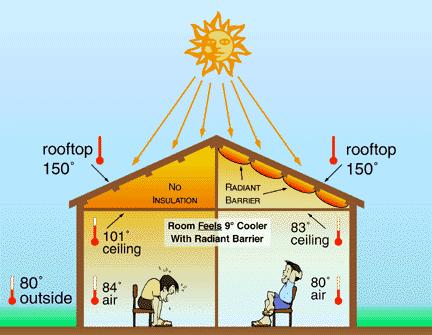
The principle of operation of both the radiant barriers is to reflect heat away from the insulation. As a part of heat is reflected back, your insulation won’t receive as much of heat as it would have in the absence of such a material. As a consequence, the amount of thermal radiation passing thru the insulating material is lowered and keeps the house cooler. So, you see the primary function of a radiant barrier is to keep heat out. As such it can’t be expected to provide much aid to insulation in winters when your home has been heated and there may not be any significant reduction of power consumption for heating in winters. Yet, the fact that it makes a substantial difference on roofs in southern states and reduces power bills to a great extent can’t be denied.
You’ll appreciate that metal in the radiant barrier goes a long way in preventing the sun from making your attic into an oven simply by reflecting heat away from the insulation without causing any chemical reaction to pollute the surrounding area. Practically it is not possible to have zero heat transfer, irrespective of the amount or type of insulation used. Transfer of heat is a natural phenomenon and is caused by the difference of temperature between any two points. The higher is this difference, the more will be the heat retransfer. By reducing the temperature in the attic, you are making it easier for the insulation to carry its job of retaining the cold air inside and the hot air is kept outside.
Quite often people argue that if the house already has adequate insulation, installation of radiant barriers can be avoided as it is not expected to make any significant benefit. This is far from being true. As already said there is a difference in the way a radiant barrier and a traditional insulating material works to keep the room warm. A radiant barrier stops the transmission of heat that would have otherwise entered into your attic by the process of radiation thru the air present around it. On the other hand traditionally employed insulating materials tend to trap the air inside and fail to transmit heat thru the process of convection of heat transfer via a media, which is air in the present case.
As a result even if you have provided adequate insulation adopting traditional insulating materials that prevents warming of your room thru convection, you can definitely benefit by installing a radiant barrier that would prevent heat from outside radiating into your house.

