

 Posts
Posts


It’s about time that you learnt about radiant barrier chips and how these could help your home. Those living in that part of the world that offers extremes of weather know how difficult it is to mange and maintain a comfortable temperature within the home at affordable prices. Even if you were in an area that has frequent changes of weather, you would have experienced the same difficulty.
In summers you have heat coming in from the roof. As a result the inside temperature rises and your cooling mechanism has to work harder to maintain internal temperature at comfortable levels. Thus, providing insulation on the roof restricts incoming heat. In winters the reverse action takes place. The internal air heated and maintained at comfortable level, tends to escape thru the roof and the same insulation retards its escape from your attic.
For reason explained above, it’s imperative to provide insulation to roofing. It slows down the process of entering or escaping the heat from a given area. Mind you, it only slows down the process of heat transfer, and that is not the best way of retaining heat within your area. Here come in radiant barrier chips. They are made of plastic that has highly reflective surfaces on both its sides. As a consequence of this reflective characteristic, these chips are able to reflect heat that would have otherwise entered your attic in summers.
During winters, the other side of the same chip with similar characteristic reflects back to room, the heat that would have otherwise escaped thru the roof.
Installation of radiant barrier chips is very simple and easy. It needs equipment the functioning of which is akin to a leaf blower. This would suck up heat from the cardboard box and randomly disperse it on the attic insulation, as that insulation alone is incapable of preventing the heat from getting in or out of the house.
Continued and prolonged exposure to dust causes these chips to lose their effectiveness. Therefore it is desirable to have more than one layer of these radiant barrier chips. Provide seven to eight layers of these in your attic. Doing so ensures that even if the top layer loses its effectiveness, the layer below continues to provide the necessary service.
Friday


Reflective Foil Insulation And Radiant Barriers
The ever increasing cost of energy is motivating technocrats and scientists to find alternate means of energy which are difficult to come by as natural resources are limited. As such a logical step would be to conserve what we have. It implies that we should make every effort to avoid wastage of energy. One way of avoiding the losses is to use proper insulating materials that give better results.
One of the insulating materials that has been in use for a very long time is fiberglass. It has excellent insulating characteristics and helps to prevent the loss of heat through convection. The performance of such materials is measured in terms of an “r” value. Generally, the thicker the material the more is its “r” value. Fiberglass as an insulating material is quite cheap, readily available and offers easy installation.
Though ideal for being used under many circumstances, fiberglass has a few limitations that restrict its use. This is prone to being attacked by rodents and insects. Further, it is unable to resist moisture beyond a point.
A slight addition of water to this material causes a substantial drop in its “r” value. That’s what makes it unsuitable for crawlspace applications and many applications involving concrete slabs. It is for this limitation that it finds very restrictive use in attic applications.

Because of the said limitations of fiberglass, there is an enlarged use of radiant barriers and reflective oil insulation products. . Radiant barriers and reflective foil insulation remain unaffected by moisture, and are not prone to insect and rodent infiltration. These are suitably modified for being used in the following applications.
House-wraps: Existing wraps often use for domestic or kitchen use are being replaced by radiant barriers. What wee have generally been using so far has a strong weave of perforated vapor barrier. Radiant barrier house-wraps have the same characteristics but an additional one too. It has a reflective layer that blocks the loss of heat thru radiation.
Attics: radiant barriers offer an excellent opportunity for being used in attic applications. Depending on weather conditions, the humidity level in an attic keeps changing. That is why most of the heat generated in winters is lost thru attics. And, in summers attics get too heated. That makes fiberglass insulation less effective as compared to a radiant barrier that reflects back radiant heat.
Under-Slabs and Basements:
Being in contact with the earth below, basements act as endless heat sinks.
As their moisture content is higher, fiberglass is not an ideal material for such applications. As reflective foil insulation is impregnable by moisture and has the characteristic of blocking radiated heat, it is an ideal material for such uses.
Crawlspaces and Duct-Wraps: Such areas offer no option but the use of reflective oil insulation. Fiberglass is ruled out as it is unable to cope with moisture and rodents.
The basic difference between radiant barrier and reflective foil insulation versus fiberglass is that the latter is designed to prevent the loss of heat thru the process of convection, whereas the former has the characteristic of preventing loss of heat thru the process of radiation. The two are designed to prevent loss of heat, each thru a different process of heat flow. So, it is not fair to compare the two materials. For being truly effective an insulating material should prevent loss of heat thru convection as well thru radiation. That can ideally be achieved by combining the properties of both the materials i.e. fiberglass and radiant barrier reflective foil insulation or any other such material. Therefore, wherever possible a combination of two such materials should be used.
One of the insulating materials that has been in use for a very long time is fiberglass. It has excellent insulating characteristics and helps to prevent the loss of heat through convection. The performance of such materials is measured in terms of an “r” value. Generally, the thicker the material the more is its “r” value. Fiberglass as an insulating material is quite cheap, readily available and offers easy installation.
Though ideal for being used under many circumstances, fiberglass has a few limitations that restrict its use. This is prone to being attacked by rodents and insects. Further, it is unable to resist moisture beyond a point.
A slight addition of water to this material causes a substantial drop in its “r” value. That’s what makes it unsuitable for crawlspace applications and many applications involving concrete slabs. It is for this limitation that it finds very restrictive use in attic applications.
Because of the said limitations of fiberglass, there is an enlarged use of radiant barriers and reflective oil insulation products. . Radiant barriers and reflective foil insulation remain unaffected by moisture, and are not prone to insect and rodent infiltration. These are suitably modified for being used in the following applications.
House-wraps: Existing wraps often use for domestic or kitchen use are being replaced by radiant barriers. What wee have generally been using so far has a strong weave of perforated vapor barrier. Radiant barrier house-wraps have the same characteristics but an additional one too. It has a reflective layer that blocks the loss of heat thru radiation.
Attics: radiant barriers offer an excellent opportunity for being used in attic applications. Depending on weather conditions, the humidity level in an attic keeps changing. That is why most of the heat generated in winters is lost thru attics. And, in summers attics get too heated. That makes fiberglass insulation less effective as compared to a radiant barrier that reflects back radiant heat.
Under-Slabs and Basements:
Being in contact with the earth below, basements act as endless heat sinks.
As their moisture content is higher, fiberglass is not an ideal material for such applications. As reflective foil insulation is impregnable by moisture and has the characteristic of blocking radiated heat, it is an ideal material for such uses.
Crawlspaces and Duct-Wraps: Such areas offer no option but the use of reflective oil insulation. Fiberglass is ruled out as it is unable to cope with moisture and rodents.
The basic difference between radiant barrier and reflective foil insulation versus fiberglass is that the latter is designed to prevent the loss of heat thru the process of convection, whereas the former has the characteristic of preventing loss of heat thru the process of radiation. The two are designed to prevent loss of heat, each thru a different process of heat flow. So, it is not fair to compare the two materials. For being truly effective an insulating material should prevent loss of heat thru convection as well thru radiation. That can ideally be achieved by combining the properties of both the materials i.e. fiberglass and radiant barrier reflective foil insulation or any other such material. Therefore, wherever possible a combination of two such materials should be used.
Monday
Radiant Barrier - How Does It Work?
In its simplest form, a radiant barrier is a type of reflective coating that is applied to the underside of a roof. It comes in different forms and can thus be applied in different ways. Its two more popular forms are: spray on and sheet barriers. In its sheet form, it comes in big roles which may be rolled out in the attic. It offers the flexibility of being laid on top of your existing insulation or nailed down to the bottom of the roof and may even be hung from rafter supports. It is becoming a practice to incorporate this sheet underneath the shingles. While a building is under construction, a radiant sheet barrier may be used on top of the roof but below the shingles. It may be used the same way for a re-roofing project.
The other kind of radiant barrier spray on is sprayed underneath the roof like paint. This has the advantage of being more durable and easier to install correctly. It is in fact a paint mixed with flecks of metal that impart it the characteristic of reflecting heat. One more advantage of spray on barriers is that it is easier to get a total coverage in comparison to sheets. But, there is a limitation too. Spray on radiant barriers fail to offer the same level of heat shielding as is provided by properly installed sheets. Many experts hold the opinion that a spray on radiant barrier is as beneficial because of its longer life and the convenience with which it can be applied all over the surface of the roof.
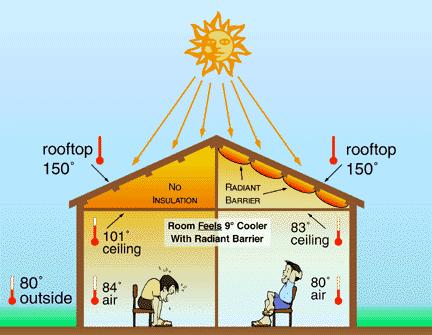
The principle of operation of both the radiant barriers is to reflect heat away from the insulation. As a part of heat is reflected back, your insulation won’t receive as much of heat as it would have in the absence of such a material. As a consequence, the amount of thermal radiation passing thru the insulating material is lowered and keeps the house cooler. So, you see the primary function of a radiant barrier is to keep heat out. As such it can’t be expected to provide much aid to insulation in winters when your home has been heated and there may not be any significant reduction of power consumption for heating in winters. Yet, the fact that it makes a substantial difference on roofs in southern states and reduces power bills to a great extent can’t be denied.
You’ll appreciate that metal in the radiant barrier goes a long way in preventing the sun from making your attic into an oven simply by reflecting heat away from the insulation without causing any chemical reaction to pollute the surrounding area. Practically it is not possible to have zero heat transfer, irrespective of the amount or type of insulation used. Transfer of heat is a natural phenomenon and is caused by the difference of temperature between any two points. The higher is this difference, the more will be the heat retransfer. By reducing the temperature in the attic, you are making it easier for the insulation to carry its job of retaining the cold air inside and the hot air is kept outside.
Quite often people argue that if the house already has adequate insulation, installation of radiant barriers can be avoided as it is not expected to make any significant benefit. This is far from being true. As already said there is a difference in the way a radiant barrier and a traditional insulating material works to keep the room warm. A radiant barrier stops the transmission of heat that would have otherwise entered into your attic by the process of radiation thru the air present around it. On the other hand traditionally employed insulating materials tend to trap the air inside and fail to transmit heat thru the process of convection of heat transfer via a media, which is air in the present case.
As a result even if you have provided adequate insulation adopting traditional insulating materials that prevents warming of your room thru convection, you can definitely benefit by installing a radiant barrier that would prevent heat from outside radiating into your house.
The other kind of radiant barrier spray on is sprayed underneath the roof like paint. This has the advantage of being more durable and easier to install correctly. It is in fact a paint mixed with flecks of metal that impart it the characteristic of reflecting heat. One more advantage of spray on barriers is that it is easier to get a total coverage in comparison to sheets. But, there is a limitation too. Spray on radiant barriers fail to offer the same level of heat shielding as is provided by properly installed sheets. Many experts hold the opinion that a spray on radiant barrier is as beneficial because of its longer life and the convenience with which it can be applied all over the surface of the roof.
The principle of operation of both the radiant barriers is to reflect heat away from the insulation. As a part of heat is reflected back, your insulation won’t receive as much of heat as it would have in the absence of such a material. As a consequence, the amount of thermal radiation passing thru the insulating material is lowered and keeps the house cooler. So, you see the primary function of a radiant barrier is to keep heat out. As such it can’t be expected to provide much aid to insulation in winters when your home has been heated and there may not be any significant reduction of power consumption for heating in winters. Yet, the fact that it makes a substantial difference on roofs in southern states and reduces power bills to a great extent can’t be denied.
You’ll appreciate that metal in the radiant barrier goes a long way in preventing the sun from making your attic into an oven simply by reflecting heat away from the insulation without causing any chemical reaction to pollute the surrounding area. Practically it is not possible to have zero heat transfer, irrespective of the amount or type of insulation used. Transfer of heat is a natural phenomenon and is caused by the difference of temperature between any two points. The higher is this difference, the more will be the heat retransfer. By reducing the temperature in the attic, you are making it easier for the insulation to carry its job of retaining the cold air inside and the hot air is kept outside.
Quite often people argue that if the house already has adequate insulation, installation of radiant barriers can be avoided as it is not expected to make any significant benefit. This is far from being true. As already said there is a difference in the way a radiant barrier and a traditional insulating material works to keep the room warm. A radiant barrier stops the transmission of heat that would have otherwise entered into your attic by the process of radiation thru the air present around it. On the other hand traditionally employed insulating materials tend to trap the air inside and fail to transmit heat thru the process of convection of heat transfer via a media, which is air in the present case.
As a result even if you have provided adequate insulation adopting traditional insulating materials that prevents warming of your room thru convection, you can definitely benefit by installing a radiant barrier that would prevent heat from outside radiating into your house.
Friday
Wednesday
Privacy Policy
This website/blog uses third-party advertising companies to serve ads when visiting this site. These third parties may collect and use information (but not your name, address, email address, or telephone number) about your visits to this and other websites in order to provide advertisements about goods and services of interest to you. If you would like more information about this practice and to know your choices about not having this information used by these companies, you can visit Google's Advertising and Privacy.
If you wish to opt out of Advertising companies tracking and tailoring advertisements to your surfing patterns you may do so at Network Advertising Initiative.
Google uses the Doubleclick DART cookie to serve ads across it's Adsense network and you can get further information regarding the DART cookie at oubleclick as well as opt out options at Google's Privacy Center.
Privacy
I respect your privacy and I am committed to safeguarding your privacy while online at this site http://radiantbarriernews.blogspot.com// The following discloses how I gather and disseminate information for this Blog.
RSS Feeds and Email Updates
If a user wishes to subscribe to my RSS Feeds or Email Updates (powered by Feedburner), I ask for contact information such as name and email address. Users may opt-out of these communications at any time. Your personal information will never be sold or given to a third party. (You will never be spammed by me - ever)
Log Files and Stats
Like most blogging platforms I use log files, in this case Statcounter. This stores information such as internet protocol (IP) addresses, browser type, internet service provider (ISP), referring, exit and visited pages, platform used, date/time stamp, track user’s movement in the whole, and gather broad demographic information for aggregate use. IP addresses etc. are not linked to personally identifiable information.
Cookies
A cookie is a piece of data stored on the user’s computer tied to information about the user. This blog doesn't use cookies. However, some of my business partners use cookies on this site (for example - advertisers). I can't access or control these cookies once the advertisers have set them.
Links
This Blog contains links to other sites. Please be aware that I am not responsible for the privacy practices of these other sites. I suggest my users to be aware of this when they leave this blog and to read the privacy statements of each and every site that collects personally identifiable information. This privacy statement applies solely to information collected by this Blog.
Advertisers
I use outside ad companies to display ads on this blog. These ads may contain cookies and are collected by the advertising companies and I do not have access to this information. I work with the following advertising companies: Google Adsense. Please check the advertisers websites for respective privacy policies.
If you wish to opt out of Advertising companies tracking and tailoring advertisements to your surfing patterns you may do so at Network Advertising Initiative.
Google uses the Doubleclick DART cookie to serve ads across it's Adsense network and you can get further information regarding the DART cookie at oubleclick as well as opt out options at Google's Privacy Center.
Privacy
I respect your privacy and I am committed to safeguarding your privacy while online at this site http://radiantbarriernews.blogspot.com// The following discloses how I gather and disseminate information for this Blog.
RSS Feeds and Email Updates
If a user wishes to subscribe to my RSS Feeds or Email Updates (powered by Feedburner), I ask for contact information such as name and email address. Users may opt-out of these communications at any time. Your personal information will never be sold or given to a third party. (You will never be spammed by me - ever)
Log Files and Stats
Like most blogging platforms I use log files, in this case Statcounter. This stores information such as internet protocol (IP) addresses, browser type, internet service provider (ISP), referring, exit and visited pages, platform used, date/time stamp, track user’s movement in the whole, and gather broad demographic information for aggregate use. IP addresses etc. are not linked to personally identifiable information.
Cookies
A cookie is a piece of data stored on the user’s computer tied to information about the user. This blog doesn't use cookies. However, some of my business partners use cookies on this site (for example - advertisers). I can't access or control these cookies once the advertisers have set them.
Links
This Blog contains links to other sites. Please be aware that I am not responsible for the privacy practices of these other sites. I suggest my users to be aware of this when they leave this blog and to read the privacy statements of each and every site that collects personally identifiable information. This privacy statement applies solely to information collected by this Blog.
Advertisers
I use outside ad companies to display ads on this blog. These ads may contain cookies and are collected by the advertising companies and I do not have access to this information. I work with the following advertising companies: Google Adsense. Please check the advertisers websites for respective privacy policies.
Subscribe to:
Posts (Atom)